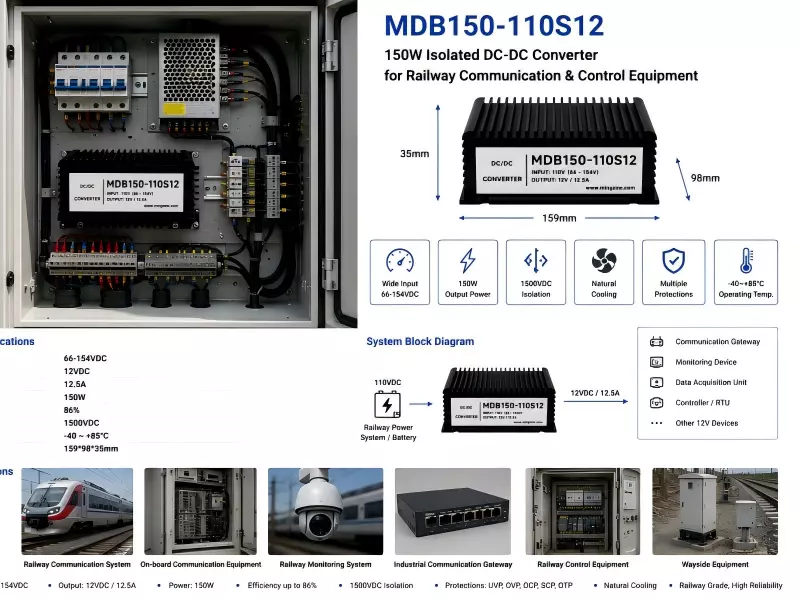



150W Isolated 110V to 12V DC-DC Converter for Railway Communication Equipment
Why Do 12V Communication and Control Devices in 110VDC Railway Systems Experience Resets, Dropouts or Unstable Operation?
Railway systems may use a 110VDC power architecture, while communication, monitoring, gateway and control electronics often require lower 12VDC auxiliary power.
For engineers, the real challenge is not simply:
“How do I convert 110VDC to 12VDC?”
The more important question is:
Will the 12V electronics remain stable when the DC bus fluctuates, loads change or electrical interference occurs?
An unstable auxiliary power supply may result in:
unexpected communication device resets;
gateway or data acquisition dropouts;
monitoring equipment failures;
intermittent control problems;
difficult-to-diagnose system faults.
Intermittent failures are particularly costly because engineers may spend significant time troubleshooting communication, wiring and software before identifying the power supply as the source.
Why Is 110VDC Railway Power Conversion Challenging?
1. A 110VDC bus does not always remain at exactly 110V
Battery conditions, charging and discharging, and changing system loads can cause the actual DC bus voltage to vary.
MDB150-110S12 accepts a 66–154VDC wide input range, allowing the converter to accommodate these variations while providing stable 12VDC auxiliary power.
2. Communication electronics are sensitive to electrical interference
Gateways, monitoring equipment, controllers and data acquisition electronics may consume relatively little power, but they can be sensitive to supply disturbances.
The isolated architecture creates electrical separation between the 110VDC power domain and downstream 12V electronics, helping reduce interference coupling between different parts of the system.
3. Load transitions require stable power conversion
Communication and control electronics do not always operate at constant load.
Startup and operating-mode changes can create dynamic power demand.
Engineers therefore need more than a converter that simply provides a nominal 12V output—they need stable power under changing operating conditions.
4. Field troubleshooting is expensive
A DC-DC converter is a relatively small part of the complete railway system.
However, intermittent power-related failures can lead to significant troubleshooting and maintenance work.
Reducing potential power-related failure points therefore creates value far beyond the cost of the converter itself.
How Does MDB150-110S12 Solve the Problem?
A dedicated isolated auxiliary power architecture can be created:
110VDC Power Bus → MDB150-110S12 → Stable Isolated 12VDC → Communication & Control Electronics
The 66–154VDC wide input range accommodates variations in the upstream DC bus.
Galvanic isolation separates sensitive 12V electronics from the higher-voltage input power domain.
The 150W power level provides practical capacity for multiple auxiliary loads such as:
communication gateways;
data acquisition modules;
monitoring devices;
control electronics;
other 12V auxiliary equipment.
Why MINGZINC?
MINGZINC develops industrial isolated DC-DC solutions around actual equipment operating conditions rather than voltage conversion alone.
Our engineering approach focuses on:
wide input voltage capability;
galvanic isolation;
EMI/EMC performance;
stable output under load changes;
thermal management and continuous operation;
electrical protection.
For OEM/ODM projects, input range, output parameters, interfaces, mounting and thermal solutions can also be adapted to specific equipment requirements.
Instead of forcing an application to fit a standard power module, we can help match the power solution to the equipment and operating environment.
What Value Does This Create for Engineers?
MDB150-110S12 creates a stable and isolated auxiliary power domain between the 110VDC bus and sensitive 12V electronics.
This can help engineers:
Reduce device resets caused by bus fluctuations;
Reduce power-related communication problems;
Improve communication and control equipment stability;
Simplify 110VDC-to-12VDC auxiliary power design;
Reduce intermittent system failures;
Reduce field troubleshooting and maintenance.
Typical Power Architecture
110VDC Railway Power / Battery Bus
↓
66–154VDC Input
↓
MDB150-110S12 Isolated DC-DC Converter
↓
Stable 12VDC Auxiliary Power
↓
Gateway / Monitoring / Data Acquisition / Control Electronics
H2: Recommended Application
Railway Communication & Control Equipment Auxiliary Power
Suitable for railway communication equipment, monitoring systems, gateways, data acquisition devices, control electronics and other equipment using a 110VDC power bus with 12VDC auxiliary loads.
For Power Supply Distributors, Railway Equipment Suppliers, System Integrators and Equipment OEMs, MDB150-110S12 can also provide an isolated 12V auxiliary power solution for 110VDC systems, with OEM/ODM customization available for specific project requirements.