
leave a message
If you are interested in our products and want to know more details,please leave a message here,we will reply you as soon as we can.




DC-DC Converters in Industrial Automation
A 24 V bus looks like the simplest thing in the plant. It is also the one that runs non-stop for a decade, feeds every inductive load on the line, and is expected to keep working while a contactor opens next to it.
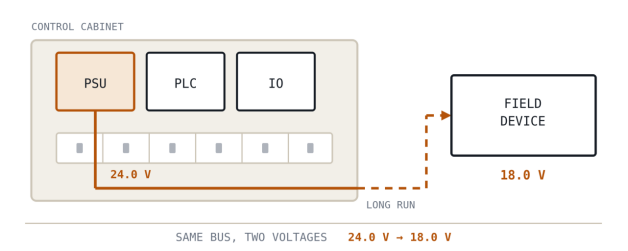
Schematic diagram, not to scale. The drop happens in the run, not in the supply.
WHY 24 V IS A RANGE, NOT A NUMBER
Industrial control power is specified as 24 V, but nothing in a real cabinet sits at 24 V. The supply is set slightly high, the cable drops voltage over thirty metres, and the load pulls the rest down when it switches on. A converter that only works at the nominal value is a converter that works in the catalogue.
The three mounting positions below fail in different ways, and each one needs a different part of the specification.
01
Inside the control cabinet
DIN-rail supplies feed PLC racks, remote I/O, signal conditioners and safety relays. This is where the 24 V bus is created, and where redundancy is decided: two supplies in parallel, decoupled by diodes, sharing a load that neither was sized for alone.
Sharing is the part that gets skipped. Droop sharing or active ORing is what makes the arrangement work, and the failure mode to design against is not a dead supply but one that sits at the wrong voltage and quietly takes the whole load.
02
Field devices at the end of the cable
Sensors, valve islands, encoders and HMI panels sit at the far end of long runs. A supply reading 24.0 V at the cabinet can present 18 V at the device under load, and the device will reset. Converting locally removes the cable from the equation.
Local conversion is not free: it puts a switching converter inside a sealed field enclosure, where the ambient is the process temperature and the housing is the only heatsink. The trade is cable drop against thermal margin, and at thirty metres it is usually worth making.
03
Motion and drive electronics
Servo drives and VFDs inject noise back onto the bus every switching cycle. The converter feeding the control side has to stay quiet through it — and keep its output within tolerance while the drive regenerates. The requirement is not low output noise on a bench; it is stability into a load that changes in microseconds.
WHAT SEPARATES AUTOMATION-GRADE FROM COMMERCIAL
Three references decide whether a part belongs in a cabinet, and all three are about what happens when conditions are bad rather than nominal:
|
Specification |
Reference |
What it settles |
|
Immunity to disturbance |
IEC 61000-6-2 |
Whether the converter survives the noise an industrial site generates |
|
Emission limits |
IEC 61000-6-4 |
Whether it adds noise the rest of the cabinet has to live with |
|
Control equipment safety |
IEC 61131-2, UL 508 |
The baseline for PLC and industrial control hardware |
The number that matters is not 24 V — it is the lowest voltage at which the load still runs, usually 18 V.
Scan to Wechat :

Scan to WhatsApp :

Hi! Click one of our members below to chat on