
leave a message
If you are interested in our products and want to know more details,please leave a message here,we will reply you as soon as we can.




DC-DC Converters for Mobile Robots and AGVs
The hard part of robot power is not the voltage. It is that the bus never sits still: a 48 V pack reads 40 V under acceleration and 60 V the instant a motor brakes downhill.
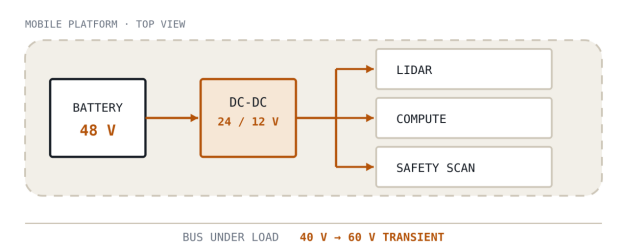
Schematic diagram, not to scale. One battery bus feeds every low-voltage rail through a single converter.
WHY THE BUS, NOT THE BATTERY, SETS THE SPECIFICATION
A mobile robot carries one battery and a dozen loads that each want a different voltage. Between them sits a converter, and it sees everything the drivetrain does to the bus — the sag when four motors start together, the overshoot when they stop, and the inrush every time the robot docks.
Designing to the nominal voltage is the most common mistake in this segment. The converter has to survive the envelope, not the label.
01
The mobile platform
AGV and AMR chassis run a 24 V or 48 V pack, four to eight drive motors, and a growing pile of electronics: lidar, cameras, safety scanners and a compute box. The converter feeding that electronics sees the full swing of a battery under load, plus the back-EMF of motors braking on a ramp.
Input range has to cover it without dropping out, and output has to stay clean enough for the sensors to trust it.
02
Joint and actuator electronics
In a collaborative arm, every joint carries an encoder, a brake and a drive. Power is distributed along the arm itself, which means the converter has to fit inside the link — often a few cubic centimetres, sometimes on a curved surface.
Inside a joint the converter is also a thermal problem: there is no airflow, the housing is the heatsink, and the ambient already includes the motor’s own losses. A part rated for 40 °C in free air is not the same part once it is sealed inside a link.
03
Charging and docking
Opportunity charging means a robot docks dozens of times a day. The charger output stage and the on-board converter both see repeated inrush and hot-plug events, and the connector is usually the first thing to fail.
Hot-plug is the test that separates a converter from a component: the input sees the full battery voltage applied in microseconds, through a connector that may bounce. Input transient suppression and inrush limiting belong to the power design, not to the accessory list.
WHAT SEPARATES ROBOT-GRADE FROM INDUSTRIAL
Three references come up repeatedly in procurement, and none of them is about the nominal voltage:
|
Specification |
Reference |
What it settles |
|
Vehicle electrical safety |
EN 1175 |
Whether the electrical system is safe on an industrial truck or AGV |
|
Immunity and emission |
IEC 61000-6-2/-6-4 |
Whether the converter survives motor noise and does not add to it |
|
Functional safety |
IEC 61508 |
Whether the power path can be part of a safety function |
The number that gets missed is not the nominal voltage — it is what the bus does in the 200 ms after a motor stops.
Scan to Wechat :

Scan to WhatsApp :

Hi! Click one of our members below to chat on